
Haircuts for round faces
Haircuts for round faces can be short, mid-length or long. Start with the outline you want to see and the routine you will actually keep.
A pixie changes the short perimeter and front; a lob keeps an edge below the jaw; longer layers retain length and movement. None is a rule for every rounded outline.

Start with the length you want to keep
The useful question about haircuts for round faces is not which shape needs fixing. It is what you want the hair around your face to do. A short perimeter, an edge below the jaw and retained long layers offer different starting points. Choose the amount you are comfortable removing before debating individual details.
Begin with two references rather than a large gallery. Compare the front, the width beside the cheeks and where the lower edge falls. Keep a feature you already enjoy, whether that is your natural curl, an open forehead or substantial length. The collection names describe selectable styles; they are not a gender judgment made from a photo.
Pixie or lob: choose the lower edge
When comparing haircuts for round faces, notice how much of the neck and jaw the reference leaves visible. A pixie makes a larger length change and leaves the front and crown available for shaping. A lob retains a longer boundary around the sides. Neither length is automatically right or wrong for a round outline.
For a pixie, ask how the front will sit without deliberate arranging and whether you want enough length to sweep it sideways. For a lob, choose its dry landing point rather than simply requesting “shoulder length.” Growth direction, density and natural movement can change the result even when two cuts share a name.
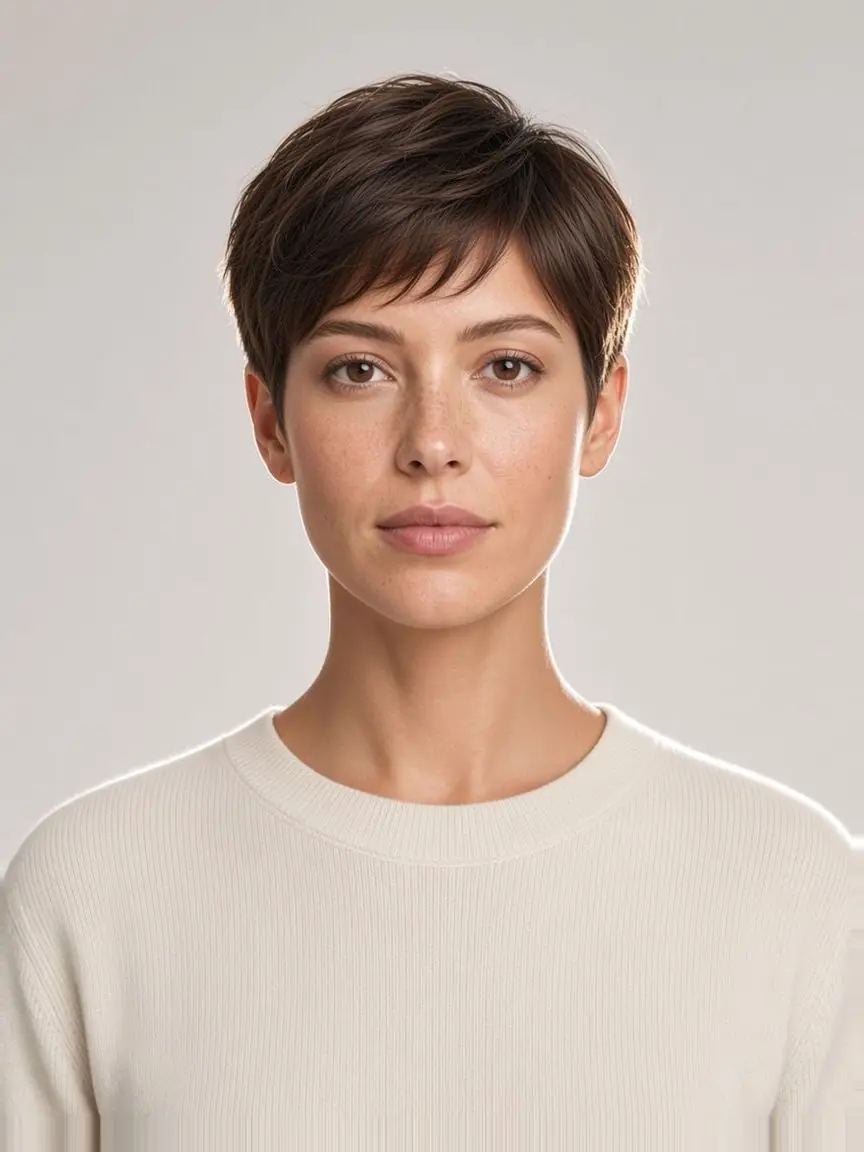
Pixie
Short sides expose the ears and neck while the longer front sweeps diagonally across part of the forehead. This reference keeps some crown height; it is not a uniformly clipped cut.
Keep enough front length for the direction you want. Discuss how it dries, and remember that a short perimeter still needs reshaping.
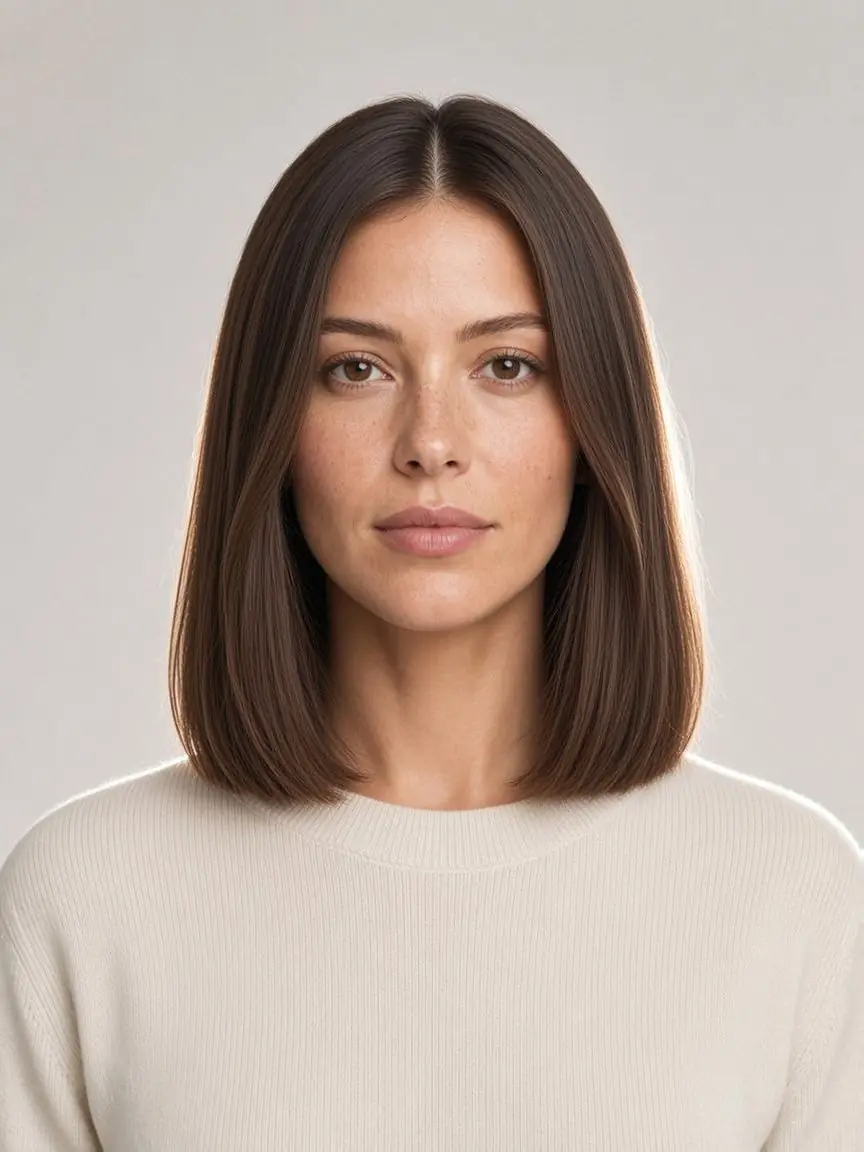
Lob
The center part leaves the forehead open, and the fairly straight perimeter falls below the jaw. Compare that retained side length with the pixie’s exposed ears and neck.
For haircuts for round faces, this is a length option, not a rule against shorter cuts. Check the dry edge and how it behaves when you skip smoothing.
AI catalog references on another model, whose face shape has not been measured here.
Curtain layers or long layers: choose the framing
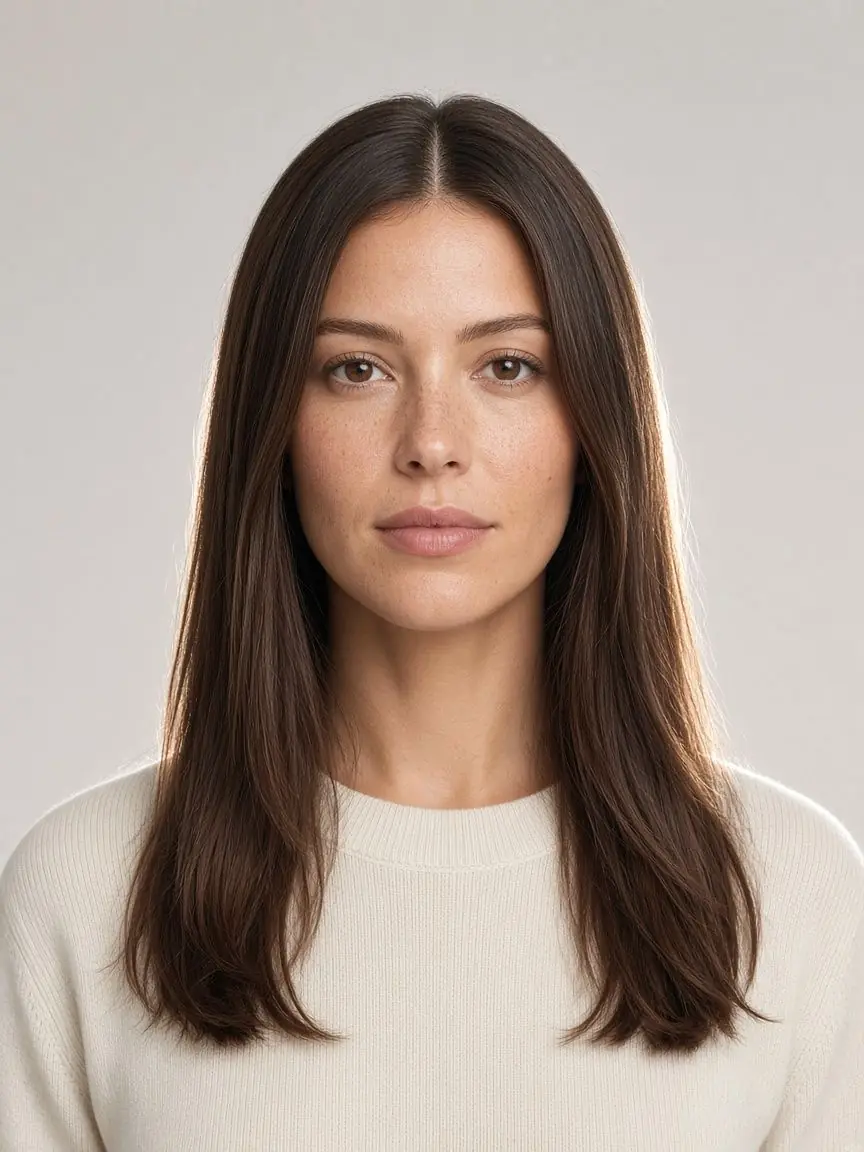
Among haircuts for round faces, layers can serve different purposes. The curtain-layers reference places shorter pieces around the front, creating an opening and movement beside the face. Long layers keep more of the overall length while changing how the lower sections separate and fall. Look at both the front and the ends.
A curtain effect needs enough front length and a workable parting; it may require placing the pieces after drying. Long layers are worth comparing when keeping length matters more than introducing a distinct fringe. Ask where the shortest layer will begin and what happens when you tie your hair back, tuck it behind your ears or let it dry naturally.
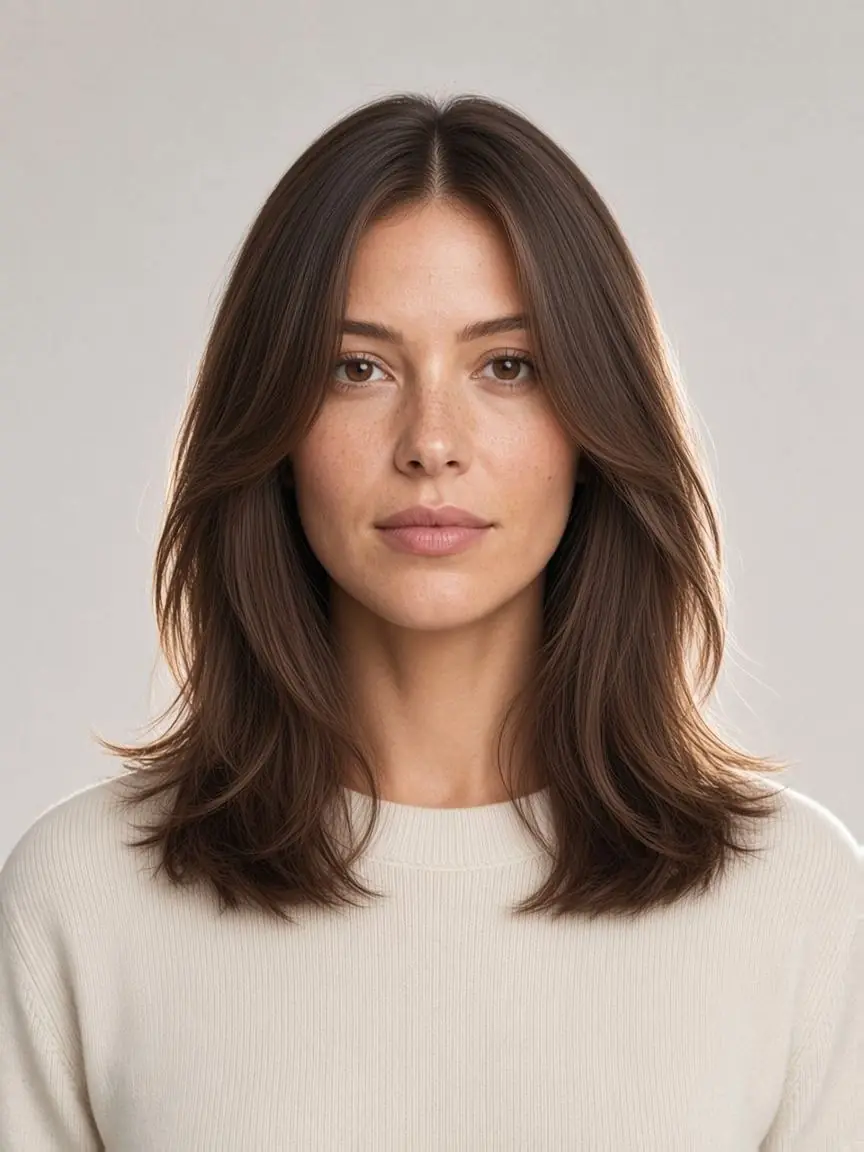
Curtain layers
The center opens above the forehead, while shorter pieces turn outward beside the face. The ends sit around the shoulders, creating a more separated frame than the lob’s contained lower edge.
Ask where the shortest face-framing pieces will land when dry and whether they need arranging. This photo does not show a heavy, closed fringe across the forehead.
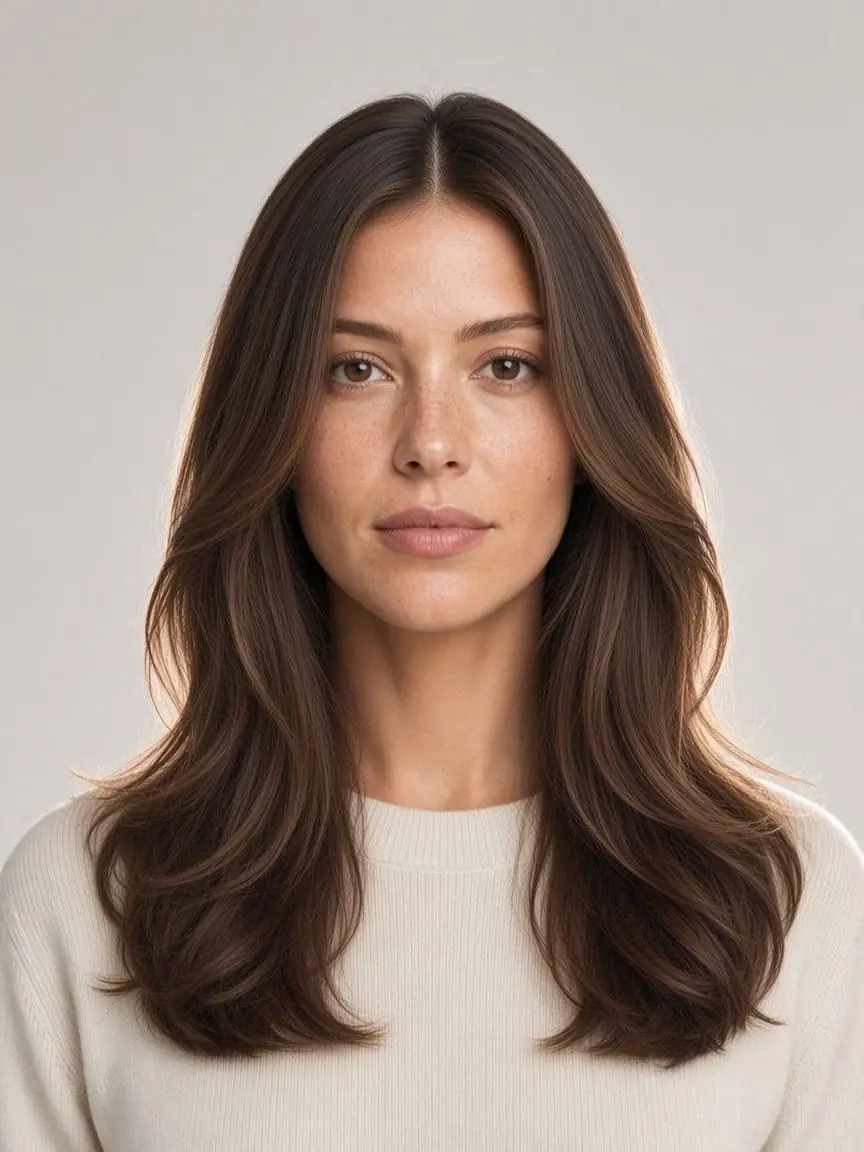
Long layers
More length remains below the shoulders, with bending layers and a fuller lower outline. Compare it with curtain layers if keeping length matters more than bringing the edge upward.
Among haircuts for round faces, this is an option for retained length rather than a promise of extra height. Consider detangling, drying and how your natural texture moves the layers.
AI catalog references on another model, whose face shape has not been measured here.
Keep your natural texture in the comparison
Texture matters as much as the names in a guide to haircuts for round faces. Fine strands may not produce a tall crown without preparation. Dense hair can retain more side volume than the reference suggests. A stylist needs to see how your hair falls, not just the outline of the person in a photograph.
Natural curls belong in haircuts for round faces without a requirement to straighten them. Compare the overall width and the dry position of the shortest pieces. Curl shrinkage, density and the way individual sections group together affect that outline. Ask how removing weight would change the shape before requesting many short layers.
The curly catalog image below illustrates one finish. It cannot establish your curl pattern or predict its behavior. For wavy or coily hair, take the desired length and weight placement from a reference, then discuss an interpretation that works with your own texture.
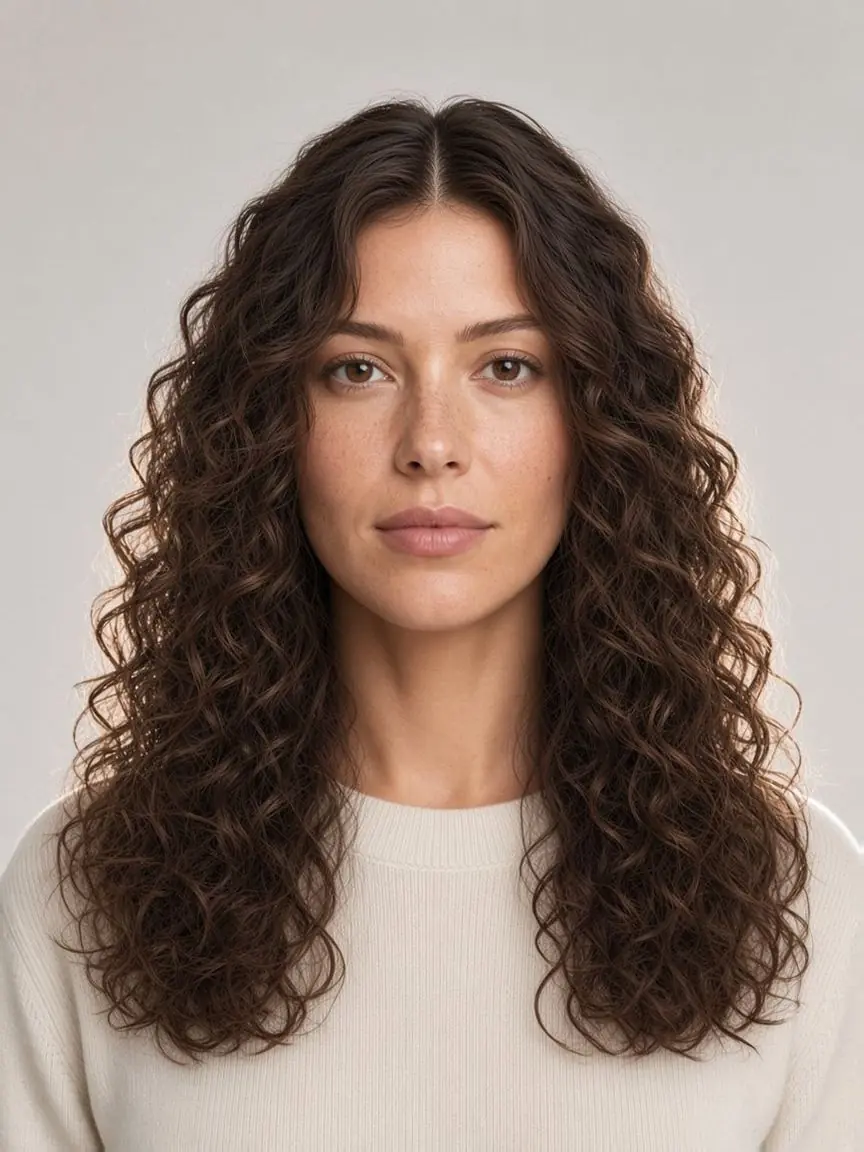
Curls
Visible curls continue through the long sides and lower edge, creating a wider outer shape than the smooth lob. Compare the whole outline rather than one straight strand.
Discuss the dry outline, shrinkage and weight placement using your own curl pattern. This AI reference cannot establish your density or predict how your curls will fall after cutting.
AI catalog reference. Curl pattern and density are not measured by this image.
If you want a longer-looking silhouette
Choosing haircuts for round faces can begin with that optional visual goal. Compare upward or diagonal movement at the front, how much width remains beside the cheeks, and where face-framing pieces end. Changing one area can make the difference easier to understand than changing the length, fringe and volume all at once.
Roundness is not a synonym for body size, and a haircut does not change facial bones or make someone lose weight. A softer or fuller outline needs no correction. If you like a wider, rounded hair shape, keep it in the comparison instead of treating elongation as a rule everyone should follow.
Haircuts over 50: start with practical conditions
Haircuts for round faces over 50 are not a separate set of permitted lengths. Compare the same pixie, lob and longer options against your current density, texture, natural gray hair and preferred care routine. Age alone does not tell a stylist where the perimeter or layers should sit.
Mention changes in dryness or manageability and whether you wear glasses. Check that front pieces sit comfortably around the frames and that the finish fits your routine. Keep length if you enjoy it; consider shorter hair if its particular tradeoffs appeal to you. Neither choice promises a younger appearance.
Shorter does not always mean less upkeep
Low-maintenance haircuts for round faces still need a realistic plan. A short perimeter can require refreshing even when daily styling is limited. A fringe may need placing after washing, while longer hair can involve more detangling and drying. Ask which part of the pictured finish depends on deliberate styling.
Compare the version you would wear on an ordinary day with the dressed-up reference. If you avoid blow-drying or styling products, say so before agreeing to a lifted front or carefully separated pieces. Maintenance is a tradeoff to discuss, not a fixed number of minutes attached to every haircut name.
Take two references and a clear brief
Use haircuts for round faces as a starting point for a conversation. Bring your two choices and explain the differences you like. Name the length to retain, where you want less or more volume, how much forehead to show and which daily steps you would rather avoid.
A useful brief is: “Keep the edge below my jaw, leave the front long enough to tuck back, and work with my natural wave.” Ask your stylist to describe the dry result and the shortest pieces before cutting. That answer is more useful than asking for a reference photograph to be reproduced exactly.
Compare an idea on your own photo
Try two haircuts for round faces when the choice is between visible changes, such as a shorter edge and retained length. The catalog actions open their actual presets in the hairstyle studio. Choosing a style does not generate an image or spend credits. You can add a photo below if you want to carry it into the comparison.
Bring one photo to your chosen cuts
You can browse first. If you want to carry a photo into the studio, prepare it here on your device. Selecting a catalog cut will not generate an image or spend credits.
JPEG, PNG, WebP or supported HEIC/HEIF · up to 20 MB.
Common questions
Which haircuts for round faces are best?
There is no single winner. Start with the length you want, then compare front direction, side volume, texture and upkeep. The hairstyle chooser can narrow the catalog using those preferences without making a face scan compulsory.
Can a round face have a bob or short hair?
Yes. A bob or pixie is a choice to examine, not an automatic exclusion. Look at its particular edge, front and volume, then consider your hair’s behavior. If the outline itself is uncertain, use the face-shape chart or optional browser detector rather than guessing from cheek fullness alone.
Is an AI preview the same as the finished haircut?
No. It is a visual idea, not a guarantee of texture, density or a stylist’s result. Generating uploads the submitted photo for cloud processing, requires sign-in and costs one credit per successful style. AI illustrations and catalog references are distinct from a new result generated from your photo.
For more inspiration, compare Allure’s haircut selection, Hair.com’s round-face guide and Vogue’s discussion of cut, texture and preference. Read the conditions around each suggestion rather than turning one photograph into an always-or-never rule.