
Heart Face Shape: Features, Comparisons and a Simple Check
Recognize a heart face shape, compare diamond and oval outlines, understand widow’s peaks and explore optional styling with a practical photo check.
A heart face shape usually describes an upper face that appears broader than the lower jaw, with a gradual taper toward a relatively narrow chin. Consider that whole pattern rather than one isolated feature. A pointed chin, prominent cheekbones or a particular hairline cannot settle the answer alone. The description is useful when it helps you explain what you see, not when it forces your face into a perfect drawing.
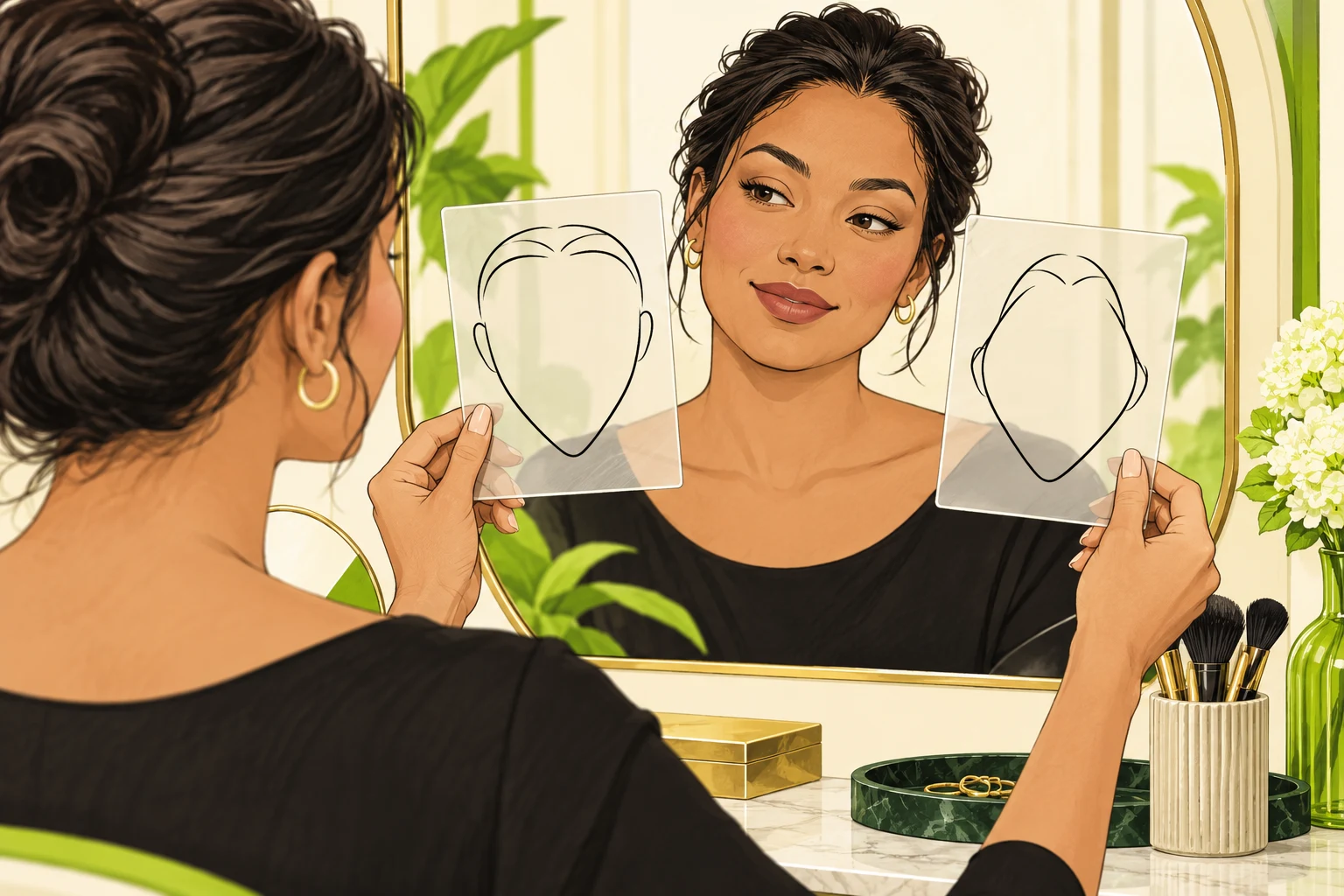
What suggests a heart face shape?
Look for a broader upper area and a narrower lower outline. The cheekbones may also be noticeable, but the key question is how the width changes as you move toward the jaw and chin. Some chins look softly rounded rather than sharply pointed. You do not need every feature in a checklist to fit one description.
The heart face shape is a styling category, not a diagnosis or a fixed personal identity. Different guides group outlines differently. Use the label alongside observable details such as “broader upper face, tapering jaw” so that your description remains useful even when another guide chooses a different name.
A widow’s peak is optional
A widow’s peak is the small downward point at the center of some hairlines. It can make the resemblance to a drawn heart more obvious, but it is not required. Byrdie’s face-shape guide explicitly includes heart-shaped outlines without requiring that feature. Compare the broader outline before deciding that a smooth hairline rules the category out.
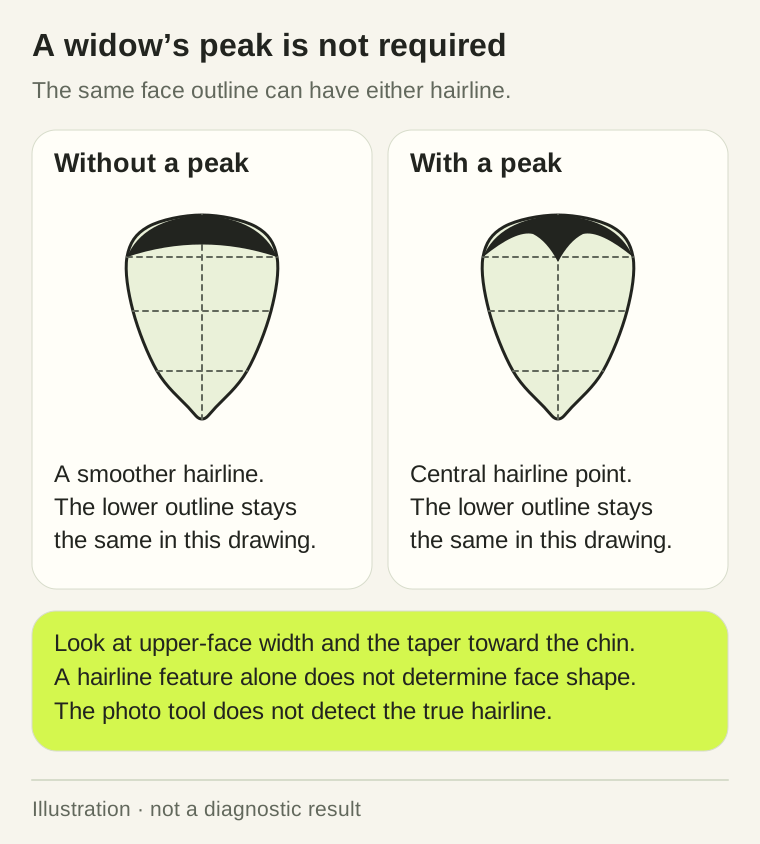
If your hair hides the upper boundary, record that uncertainty. The heart face shape does not depend on creating a more pointed hairline or exposing more forehead than you are comfortable showing. A clearer reference photo simply makes comparison easier.
A repeatable photo check
Use a mirror or one clear, straight-on portrait. Keep the head upright, camera around eye level and expression relaxed. Even light helps you see both sides. Pull fringe away if possible and leave the whole chin in view. Avoid comparing a tilted selfie with a front-facing chart as though the perspectives were identical.
- Inspect the upper face. Note the visible width around the temples and forehead. Do not confuse the width of a hairstyle with the width of the face underneath.
- Compare the cheek area. Ask whether the cheeks stand out against a noticeably narrower upper face, or whether the upper area remains broad.
- Follow the jaw toward the chin. Look for tapering rather than a jaw that widens below the cheeks. A beard or shadow can hide that boundary.
- Write the observations first. “Broad upper face, narrower jaw” is a useful result. Consider a heart face shape only after you can identify that pattern consistently.
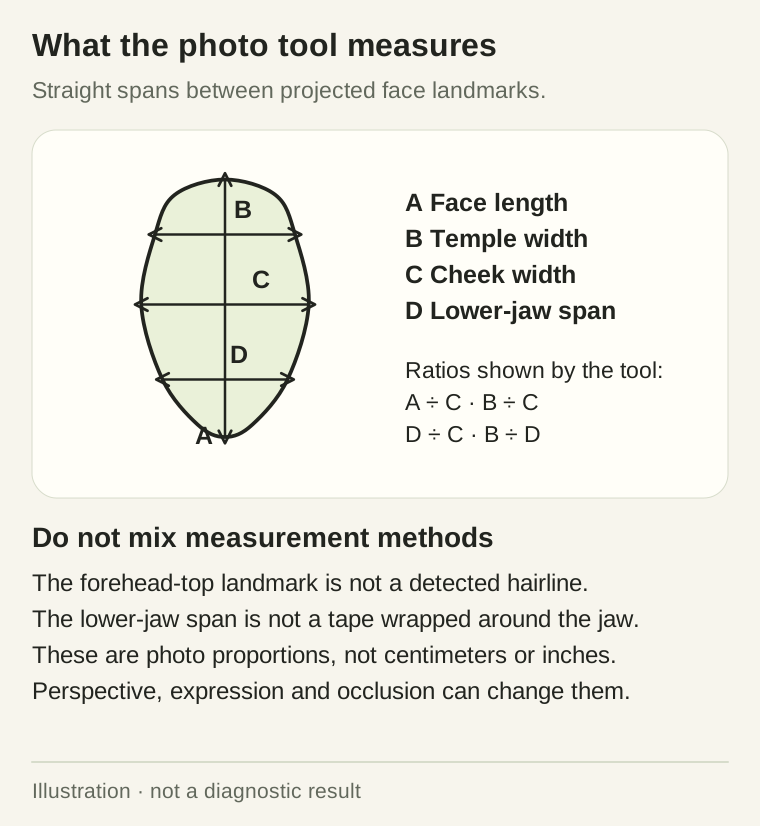
For heart face shape measurements, stay within one method. You can compare straight distances in the same photograph without assigning ideal ratios. A tape running along both jaw sides measures something different from a straight segment between visible jaw points. Do not combine their values or use the detector’s internal cutoffs as universal instructions for measuring a face by hand.
If the result changes between photos, inspect angle, lighting and hidden boundaries before choosing which label to trust. You can also keep two possible descriptions. Agreement across a few clear observations is more useful than repeatedly scanning an image that does not show the relevant features.
Heart, diamond, oval or triangle?
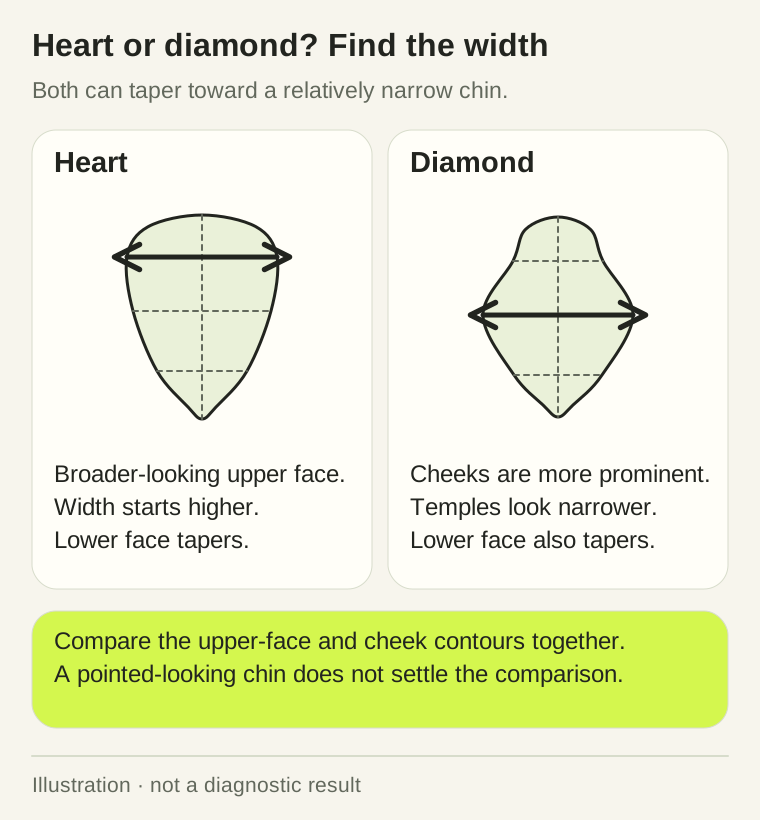
Heart versus diamond: find the broadest area
A heart face shape and a diamond outline can both taper toward the chin. Compare the upper face with the cheeks. Heart usually retains more upper-face width; diamond places more emphasis on cheeks against narrower temples. Prominent cheekbones alone do not establish either label. Look at the relationship between all three zones: upper face, cheeks and jaw.
Heart versus oval: inspect the taper
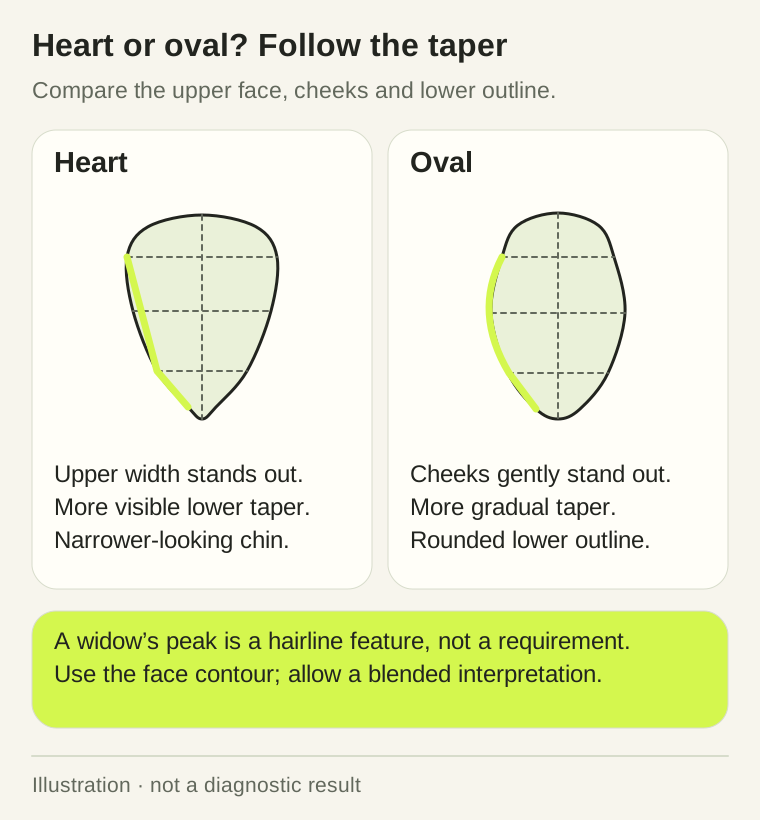
An oval description often follows a softer, more gradual outline without one upper zone dominating. A heart face shape emphasizes the difference between the broader upper face and narrower lower jaw. Length alone does not separate them. If you see a longer, rounded outline with only a mild taper, keep that mixed description rather than forcing a choice from the chin alone.
Compare the oval face shape guide when gradual narrowing fits better than a noticeably broad upper face.
Triangle and inverted triangle: check the naming convention
Some styling guides use inverted triangle for essentially the same top-wide, chin-narrow silhouette as heart. LensDirect’s heart-face guide uses that upside-down-triangle comparison. There is no need to invent a precise biological boundary between the two labels.
In this site’s seven-category vocabulary, triangle means a wider jaw and narrower upper face: the reverse taper of a heart face shape. Always check which end a guide means is widest. These short descriptions make the naming difference explicit:
- Heart / inverted-triangle usage: broader upper area, narrowing lower outline.
- Diamond: cheek area stands out against narrower upper and lower zones.
- Triangle in our chart: lower face is comparatively wider than the upper area.
The seven-shape comparison chart puts those names in one consistent reference. Its drawings are illustrations, not anatomical templates.
Optional styling, without a correction rule
You do not need to change a heart face shape. If you want to explore how a hairstyle frames it, choose one effect to compare: revealing or covering part of the forehead, adding fullness near the jaw, or changing height above the head. Those are preferences, not requirements for making a face “balanced” or attractive.
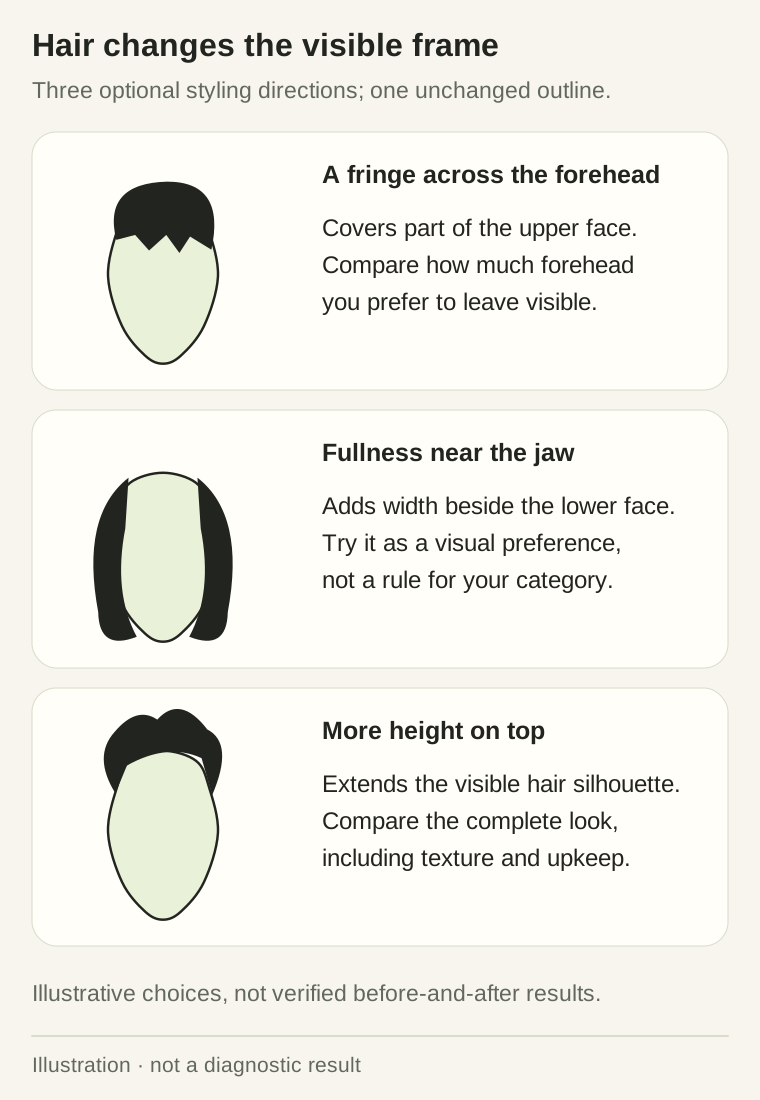
A bob, lob or layers around the jaw can be options if you want more visual fullness there. A different parting or fringe changes how much upper face is visible. None is automatically the best choice for every heart face shape. Hair texture, density, growth direction and the time you want to spend styling remain important. Bring two reference looks and your actual observations to a stylist instead of asking a shape label to decide everything.
Men, beards and glasses
The same outline vocabulary can be useful across genders. For a heart face shape, beard fullness may change the visible lower silhouette and obscure the jaw landmarks. Compare the visible facial boundary where you can, and acknowledge where you cannot see it. The men’s detector changes the style suggestions; it does not infer gender from your photograph.
For glasses, compare frames on your own face and notice the visual weight you prefer around the upper and lower outline. Check practical fit and comfort separately from style. A heart face shape does not determine a required frame, and this article makes no claims about treating eye strain or improving vision through a face-shape match.
What to do with a tentative answer
Keep a short note such as “broader upper face, softly tapered jaw; heart or oval description.” That note is a usable answer even if you never upload an image. It tells you which features to compare and which parts remain uncertain. Do not turn a tentative heart face shape into a judgment about your appearance.
For an optional second look, open the face shape detector. It estimates a category from a photo locally in the browser and shows four landmark proportions. It does not measure the true hairline or diagnose your anatomy. The hairstyle studio is a separate next step: guest previews are illustrations, while actual AI hairstyle generation requires sign-in and available credits.
Common questions
Can I have a heart face shape without a widow’s peak?
Yes. The broader-upper-face and narrower-jaw pattern can exist with a smooth hairline. A widow’s peak is one hairline feature, not an entrance requirement for the category. If the upper face is hidden, treat that part of your check as uncertain.
Is a heart face shape rare or more attractive?
This guide does not establish a reliable population rate, and the label does not determine attractiveness. The useful outcome is a clearer description of visible features and a styling choice you enjoy. It is not a ranking of face types.
What if heart face shape examples do not look like me?
Illustrations simplify real faces. Compare the feature relationships instead of matching every contour, hairstyle or facial detail. If your observations span two categories, keep both and describe what you actually see. An imperfect silhouette match is not a personal flaw or a failed test.